Australia’s emissions reduction target of 43% and 82% renewable energy by 2030 relies on a rapid transition to wind, solar and storage.
Australia is unlikely to meet its 82% renewable energy target by 2030. While progress is being made, current projections by Rystad Energy suggest Australia will fall short of the target, potentially reaching around 60% renewable energy by 2030. Over the past year to August 2025 renewable energy supplied 42% of energy to the National Electricity Market (NEM). To reach the 82% target, Australia needs to significantly accelerate the deployment of new large-scale renewable generation capacity, including wind and solar projects, and storage.
Coal is retiring fast. The next decade is critical to build the necessary energy storage for energy security.
Ten large coal-fired generators have closed since Munmorah ceased operations in 2012, the latest being Liddell in 2023. All but one of the remaining fleet of coal generators are scheduled to be closed by 2035.
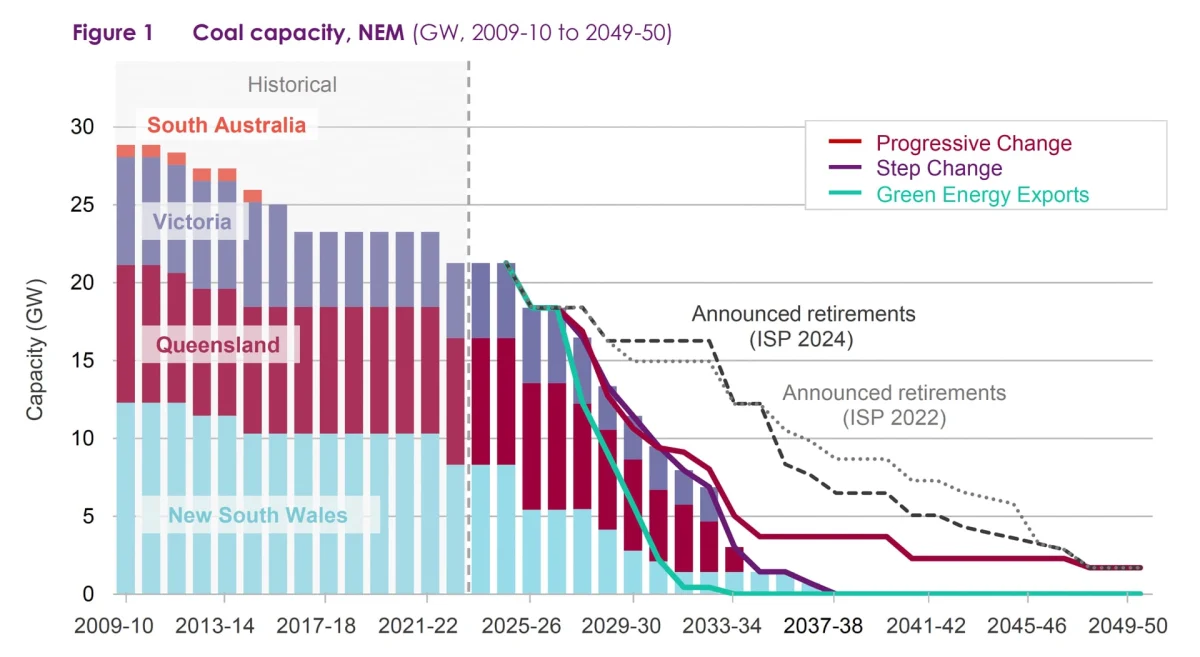
The Australian Energy Market Operator’s 2024 Integrated System Plan (ISP) forecasts that the remaining coal fleet will close much faster than the 2022 ISP and company announcements. In the most likely Step Change scenario, about 93% of the current 21.3 gigawatts (GW) of coal capacity would retire by 2034-35, and all before 2040. Even in the slower Progressive Change scenario, only 4 GW of coal generation would remain in 2034-35.
Coal retirements may occur even faster than these forecasts. Ownership has become less attractive, with higher operating costs, reduced fuel security, high maintenance costs and greater competition from renewable energy in the wholesale market. Coal generator owners are only required to give three and a half years’ notice.